Leave Your Message
0%

When you’re choosing Elementary Student Desks in 2026, it’s not just about comparing prices, colors, and delivery dates. Honestly, the desk affects posture, movement, group work, classroom visibility, and the everyday rhythm of teaching. School leaders should think about student age, body size, room layout, storage needs, and how easy the desks are to clean. Adjustable height matters—and so does stability. Maybe even more than people expect.

So, Peter Barrett — he's a school design expert and lead author on the HEAD project — found that the physical characteristics of classrooms can explain 16% of the variation in pupils’ learning progress. His research basically backs up a pretty practical idea: furniture shouldn't sit outside the learning strategy; it should be part of it. Companies like Virco and Smith System do give you some handy benchmarks for durability, ergonomics, and classroom flexibility. That said, product claims still need a careful check. Schools really ought to ask for the weight limits, what materials are used, the warranty terms, and any independent testing records. Honestly, a glossy catalog alone just isn't enough proof.

The right Elementary Student Desks? They really need to work for actual classrooms—not just the neat catalog version. Think crowded group projects, quiet independent work, all of it. So look for rounded edges, sturdy frames, smooth surfaces, and sizes kids can actually reach. And think about how teachers will be dragging those desks around at 8 a.m. A perfect layout basically never survives a whole school day. Also, some recommendations just won’t work in older buildings—narrow aisles and uneven floors can throw a wrench in things. That’s a limitation worth being honest about. So, this guide compares the practical options for 2026—mixing expert evidence with real-world buying experience. And it doesn't stop there. It also asks the tougher question: will these Elementary Student Desks still be useful once trends change?
2026 How to Choose Elementary Student Desks for Schools?

Understanding Elementary Student Desk Needs in 2026

In 2026, elementary student desks must support more than handwriting. Children shift between reading, drawing, tablets, and group discussions. A desk suited to one posture may restrict the next. Teachers often notice this during the first busy hour: knees hit panels, pencils roll, and crowded surfaces slow learning. Measure student height, chair height, and classroom pathways before choosing furniture. Fit matters more than appearance.

A practical desk should provide stable writing space, rounded edges, and leg clearance for growing children. Adjustable height can serve different age groups, but controls must be simple and secure. Students should not need adult help every time.

Consider lightweight designs for room changes, while checking whether they slide too easily on hard floors. Storage also deserves attention. A shallow tray holds notebooks, but it may collect crumbs and broken crayons. Easy cleaning matters.

Schools comparing China Elementary Student Desks should examine material strength, finish safety, repair access, and supplier documentation. Request load-test results, dimensional charts, and sample units before placing a large order. Photographs can hide wobbling joints and sharp underside corners. A sample reveals them quickly.

Still, no checklist predicts every classroom problem. Some efficient-looking desks feel restrictive after weeks of use. Observe students working, ask teachers what failed, and revise the specification. Comfort is difficult to measure, but fidgeting, slouching, and frequent desk movement provide useful evidence.

Evaluating Desk Sizes for Different Elementary Grade Levels

2026 How to Choose Elementary Student Desks for Schools?

Desk size should follow the child, not only the classroom floor plan. Young students need stable surfaces that support drawing, reading, and short writing tasks. For kindergarten and first grade, a desk height of about 20–22 inches often fits smaller bodies. A width of 22–24 inches leaves space for pencils without crowding. Feet should rest flat, with knees near a right angle.

In grades two and three, many students need desks around 22–24 inches high.

A 24–26-inch work surface can hold notebooks, folders, and a tablet. For grades four and five, heights near 24–26 inches may provide better elbow support. Desk depth should usually allow a book to open without hanging over the edge. Measure real students when possible.

These ranges are useful, but imperfect. Children in one grade can differ significantly in height and reach. In classroom evaluations, staff should check posture after several minutes, not only during a quick trial. Shoulders should remain relaxed, and students should not lean forward to see their work.

Adjustable or Custom Elementary Student Desks can support mixed-height classrooms, especially when one standard size creates discomfort.

Storage also matters. A shallow tray may prevent clutter, while a heavy frame can make daily movement difficult.

I would recheck desk fit each school year. Furniture decisions can age faster than expected.

Choosing Safe, Durable, and Child-Friendly Desk Materials

Choosing Safe, Durable, and Child-Friendly Desk Materials

Elementary Desks face daily spills, sharp pencils, restless movement, and frequent cleaning. Material selection must address all four problems. In school purchasing projects, I look for rounded edges, stable frames, and surfaces without exposed splinters. Powder-coated steel and high-pressure laminate can resist impact and repeated wiping. However, no material stays perfect forever. A scratched surface can collect dirt, so replaceability matters as much as strength.

Indoor air quality deserves equal attention. The U.S. Environmental Protection Agency reports that indoor pollutant levels can be two to five times higher than outdoor levels. Choose low-emitting adhesives, coatings, and composite panels. Ask suppliers for formaldehyde and volatile organic compound test results. The World Health Organization’s 2021 air-quality guidelines set annual PM2.5 guidance at 5 micrograms per cubic meter. Desk materials do not control classroom air alone, but they can reduce avoidable emissions.

Safety testing should include stability and edge performance. The U.S. Consumer Product Safety Commission estimated about 22,000 furniture tip-over injuries annually from 2018 to 2022. Desks are smaller than wardrobes, yet lightweight designs can still slide or overturn during active learning. Select non-slip feet and frames tested under realistic loads. Cleanable surfaces are useful, but overly textured finishes may trap residue. That trade-off is easy to miss. A child-friendly desk should feel warm, smooth, quiet, and forgiving—not merely durable.

Comparing Individual, Collaborative, and Flexible Desk Designs

2026 How to Choose Elementary Student Desks for Schools?

Individual desks support concentration, personal storage, and clear teacher sightlines. They work well during handwriting, testing, and quiet reading. A 2023 classroom ergonomics review also links suitable seat height with better posture and reduced discomfort. Choose adjustable dimensions when possible. A child should place both feet flat, with elbows resting comfortably near the desktop. Small details matter.

Collaborative desks suit peer discussion, science projects, and shared problem-solving. The Education Endowment Foundation reports that collaborative learning can add about five months of progress, although the evidence depends on careful group structure. OECD PISA 2018 data found that students valuing cooperation scored 28 points higher in reading, after accounting for socioeconomic background. The result shows association, not proof of causation. Round or trapezoid desks can support eye contact, but they may create noise and crowded walkways.

Flexible desks offer quick changes between individual and group work. Lightweight tables, lockable casters, and several heights make rearrangement practical. However, flexibility is not automatically effective. A 2022 systematic review of flexible learning environments found promising engagement benefits, but limited long-term evidence for academic gains. Schools should test a small classroom first. Observe pencil control, movement, storage, and teacher access. Some pupils may focus better alone. Others need a nearby partner. The perfect layout does not exist. Even a thoughtful plan may need revision after one rainy Monday.

Checking Ergonomics, Adjustability, and Classroom Comfort

2026 How to Choose Elementary Student Desks for Schools?

Choosing elementary student desks in 2026 should begin with the child, not the catalog. A desk that fits one eight-year-old may restrict a taller classmate. Measure seated height, elbow position, and knee clearance before placing a large order. When reviewing Wholesale Elementary Student Desks, schools should request size charts, adjustment ranges, and load information. That evidence supports a more reliable purchasing decision.

Good ergonomics keep feet supported and shoulders relaxed during writing. The desktop should sit near elbow height, with enough depth for a workbook and pencil case. Rounded edges matter when children move quickly between activities. Adjustable legs or seat heights can serve growing students for several years. Yet adjustability is not automatically useful. If controls are difficult, staff may leave them untouched. Test each mechanism with teachers and children before installation. Watch for wobbling, trapped fingers, or distracting noise.

Classroom comfort also depends on movement and room layout. Leave clear pathways so students can stand, collaborate, or reach storage without bumping desks. A stable surface should resist light pushing but remain practical to relocate. Check chair contact points, ventilation around the legs, and cleaning access. In real classrooms, small flaws become daily frustrations. I would avoid choosing only by price, but expensive features also deserve scrutiny. A short pilot with several body sizes can reveal problems that measurements miss. One assumption may still be wrong.

2026 How to Choose Elementary Student Desks for Schools? - Checking Ergonomics, Adjustability, and Classroom Comfort

Evaluation Dimension Recommended Target or Reference Data Why It Matters School Inspection Check
Student age and body-size coverage Select furniture by student height and lower-leg length rather than age alone. Elementary classrooms commonly need several size options covering approximately 6–12 years. Children of the same age can differ substantially in height, leg length, and sitting height. Measure a representative group of students and confirm that their feet can rest on the floor while their knees remain comfortably bent.
Seat height For many elementary users, provide an adjustable range of about 350–460 mm, or use several fixed sizes. EN 1729 reference seat-height sizes include approximately 350, 380, 430, and 460 mm. Correct seat height supports stable feet, relaxed legs, and a more level working posture. With the student seated, both feet should rest fully on the floor and the knees should be close to a right angle without pressure behind the knees.
Desk or work-surface height A practical elementary range is approximately 590–760 mm, depending on student size. EN 1729 reference desk heights include about 590, 640, 710, and 760 mm. The work surface should support writing and reading without forcing the shoulders to lift or the trunk to bend excessively. When seated, the student’s forearms should reach the surface comfortably with relaxed shoulders and elbows near a 90-degree angle.
Seat depth and thigh support The seat should support most of the thigh while leaving roughly 2–3 cm between the front edge of the seat and the back of the knee. A seat that is too deep can press behind the knees; one that is too shallow provides insufficient thigh support. Ask students to sit fully back and check that the seat edge does not contact the knee area.
Backrest support Use a backrest that supports the lower and middle back without restricting shoulder movement. A slightly reclined back angle of approximately 95–105 degrees is a practical classroom target. Back support helps reduce slouching during extended reading, writing, and computer activities. Check that the backrest contacts the student’s back comfortably and does not force the shoulders forward.
Adjustability and growth allowance Prefer independent seat and desk-height adjustment, with secure locking points and clear increments of approximately 20–30 mm or continuous adjustment where practical. Independent adjustment allows one desk to fit more students and reduces premature replacement as children grow. Operate every adjustment, verify that locks engage fully, and check that no pinch points are accessible during normal use.
Work-surface size For individual work, a surface around 600 × 450 mm is a practical minimum for a workbook, writing materials, and a small device. Larger surfaces may be needed for art or project work. Adequate space reduces clutter and allows students to position learning materials without twisting their bodies. Place the usual textbook, notebook, pencil case, and tablet on the desk and confirm that essential materials fit without overlapping.
Legroom and posture clearance Provide unobstructed knee and foot space, with no sharp crossbars located where students need to place their feet or move their legs. Restricted legroom encourages twisting, sideways sitting, and unstable foot placement. Have students enter, sit, change posture, and exit the desk without hitting supports or neighboring furniture.
Desk stability and load performance Choose a rigid frame with level-adjusting feet where needed. The desk should remain stable during normal writing, leaning, and accidental contact. Unstable furniture distracts students, increases spill risk, and may create safety hazards. Apply normal hand pressure to each corner, check for rocking, and inspect joints, fasteners, and leveling feet.
Edge and corner safety Use rounded or radiused edges, smooth surfaces, and securely finished corners. Avoid exposed sharp metal, splinters, and protruding hardware. Children frequently move around desks, making impact and snag hazards important considerations. Run a hand over all accessible edges and inspect the underside, adjustment points, and bag hooks.
Mobility and classroom reconfiguration Use manageable desk weights, reliable glides or casters where appropriate, and layouts that allow quick transition between individual, paired, and group work. Flexible furniture supports different teaching methods while reducing lifting strain for staff and students. Time a supervised room change and check that desks move smoothly without excessive noise or floor damage.
Storage and cable management Include only the storage needed for daily materials. Any book box, basket, or cable route should not reduce legroom or create a trip hazard. Organized storage keeps learning materials accessible while preserving a clear posture and movement zone. Load the desk with typical supplies and confirm that bags, cables, and books do not obstruct feet or aisles.
Surface, cleaning, and durability Select a non-porous, scratch-resistant, easy-to-clean surface with sealed joints and corrosion-resistant hardware suitable for frequent school cleaning. Classroom furniture is exposed to spills, markers, disinfectants, abrasion, and repeated daily use. Test cleaning compatibility on a concealed area and inspect for swelling, coating damage, loose edges, and corrosion.
Acoustics and classroom comfort Use quiet glides or soft-contact feet and avoid rattling frames. Choose finishes that reduce glare rather than highly reflective surfaces. Lower noise and visual glare can improve comfort during instruction and independent work. Move and reposition several desks during a normal lesson simulation; check sound, vibration, and reflected light.
Standards, documentation, and pilot testing Request dimensional drawings, adjustment instructions, load information, material details, cleaning guidance, and relevant school-furniture test documentation. Pilot the furniture for at least one classroom group before a large purchase. Documentation supports consistent procurement, while real-user testing reveals comfort and maintenance issues that specifications may miss. Collect feedback from students, teachers, facilities staff, and accessibility personnel, then record defects and adjustment needs before approval.

Reference note: Dimensions shown are practical purchasing targets and representative EN 1729 furniture-size values. Final selection should be verified against local regulations, student measurements, accessibility requirements, and the school’s teaching layout.

Reviewing Storage, Mobility, Cleaning, and Maintenance Features

Choosing High-Quality Elementary Student Desks requires more than checking price and appearance. Storage should fit pencils, books, and small learning tools without creating sharp clutter. A 2023 UNICEF and WHO Joint Monitoring Programme report found that 23% of schools worldwide lacked basic hygiene services in 2022. Desks should therefore have smooth, sealed surfaces that staff can wipe quickly. Avoid deep grooves and exposed screws. They collect dust and slow daily cleaning.

Mobility also deserves practical testing. Lightweight desks with secure glides can support group activities, yet desks must not slide during writing. In a real classroom, teachers should move six desks across the floor before purchasing. That small trial reveals noise, tipping risks, and awkward handles. Locking casters may help older pupils, but younger children can misuse them. The choice is not always obvious.

Maintenance affects the total cost. The U.S. Government Accountability Office reported that public school districts faced major facility repair and modernization needs in its 2020 review. Desks with replaceable feet, accessible fasteners, and repairable parts can reduce unnecessary disposal. Check whether screws loosen after repeated movement. Check the underside, too. Some designs look durable but fail there. A school may need stronger storage panels, while another may prioritize easy sanitation. Procurement teams should record cleaning time, damaged components, and teacher feedback after one term. The data may challenge the original decision.

Planning the Budget, Purchase Process, and Classroom Layout

Choosing elementary student desks in 2026 requires more than comparing unit prices. The National Center for Education Statistics reported nearly 49.5 million public elementary and secondary students in fall 2022. Even a small procurement mistake can multiply quickly.

Set a realistic budget with three layers: desk cost, delivery, and replacement allowance. I would reserve 8–12% for damaged parts, changing enrollment, and unexpected installation needs.

That figure is a planning choice, not a universal rule. Each school should test it against local prices and maintenance records.

The purchase process should begin with a classroom audit. Record student ages, room measurements, storage needs, and accessibility requirements. Request samples before approving a large order.

Check height adjustment, rounded edges, writing-surface durability, noise, and cleaning time. The U.S. Government Accountability Office found that many school facilities face significant maintenance needs, so easy-to-repair furniture deserves attention (GAO-20-494, 2020).

For layout, draw desks at actual scale. Preserve clear teacher paths and avoid blocking doors, windows, or ventilation. A flexible arrangement can support pairs, small groups, and independent work. Keep movement lanes visible.

Do not overpack the room. The OECD’s Education at a Glance 2024 emphasizes the importance of learning environments and resource allocation. A first layout may look efficient but feel cramped. Test it with backpacks and winter clothing. That detail is easy to miss.

Purchase in phases when funding is uncertain, but confirm matching dimensions before expanding. Weak planning often hides in small assumptions.

Modern Style Study Chair and Table for Students: Comfort, Functionality, and Contemporary Design

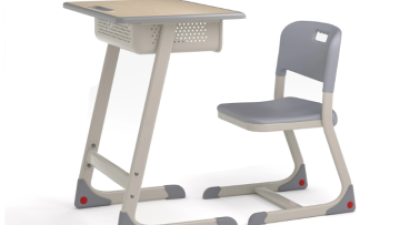
The GD-D02 study chair and table brings a modern, practical look to today’s learning spaces. Its clean lines and plastic backboard create a contemporary appearance that fits naturally into classrooms, study rooms, and training areas. Available in a variety of colors, the set can add energy and visual interest to the environment while helping create a more welcoming atmosphere for students. The smooth plastic surface is also simple to maintain, making it easy to wipe away dust, stains, and everyday marks.

Designed with functionality in mind, this student desk and chair set is lightweight and convenient to transport or rearrange. Teachers can adjust the classroom layout with less effort, while students benefit from a flexible setup that supports different learning activities. The chair’s shaped backboard provides comfortable support during lessons, and the spacious tabletop offers room for books, writing materials, and personal devices. With its combination of comfort, easy care, mobility, and contemporary design, the GD-D02 is well suited to modern educational spaces.

FAQS

What should an elementary student desk support?

It should support writing, reading, drawing, tablet use, and group discussions. One posture is not enough. Stable surfaces and clear legroom matter daily.

What desk height suits younger elementary students?

Kindergarten and first-grade desks often measure about 20–22 inches high. A 22–24-inch width leaves room for pencils and notebooks. Feet should rest flat.

How should desk sizes change for older students?

Grades two and three often need desks around 22–24 inches high. A 24–26-inch surface can hold folders, books, and a tablet. Grades four and five may need 24–26-inch heights.

Is one standard desk size suitable for every child?

Not always. Children in one grade can vary greatly in height and reach. Adjustable desks may help mixed-height classrooms. Check posture after several minutes, not just during a quick trial.

What storage features are useful?

A shallow tray can hold pencils, notebooks, and small learning tools. Deep grooves may collect crumbs and broken crayons. Storage should reduce clutter without adding sharp edges.

How can schools test desk mobility?

Move six desks across the actual classroom floor. Watch for noise, tipping, awkward handles, and excessive sliding. Secure glides can improve stability. Lightweight designs are useful, but sometimes they move too easily.

Which surfaces are easiest to clean?

Smooth, sealed surfaces allow quick wiping between activities. Avoid exposed screws and deep grooves. They collect dust and slow cleaning. Cleaning time should be recorded after real classroom use.

How can schools judge long-term durability?

Request load-test results, dimensional charts, and a physical sample. Inspect joints, underside corners, fasteners, and replaceable feet. Photographs can hide wobbling parts. A sample reveals problems quickly, though not every problem.

What evidence shows that a desk does not fit students?

Watch for fidgeting, slouching, raised shoulders, and frequent desk movement. Knees may hit panels. Pencils may roll from crowded surfaces. Teacher feedback after one term can challenge the original decision.

Conclusion

Choosing the right Elementary Student Desks in 2026 requires schools to balance student needs, classroom goals, safety, and long-term value. Desk sizes should match different elementary grade levels, allowing children to sit comfortably and maintain good posture. Materials should be strong, easy to clean, child-friendly, and free from hazardous features. Schools should also consider whether individual desks, collaborative tables, or flexible designs best support teaching methods and classroom activities.

A well-planned selection should include ergonomic features, suitable adjustability, and enough comfort for extended learning. Storage space, smooth mobility, simple maintenance, and durable construction can improve daily classroom organization. Finally, schools should review the total budget, purchasing process, available classroom space, and furniture arrangement before making a decision. By evaluating these factors together, educators can create adaptable, comfortable, and welcoming learning environments that support students’ development and changing educational needs.

Sebastian

Sebastian

Sebastian is a dedicated marketing professional at Guangzhou Gaudi School Furniture Manufacturing Co., Ltd., where he leverages his extensive expertise in the industry to drive the company's growth. With a profound understanding of school furniture products, Sebastian plays a pivotal role in......
Previous China Top 10 Study Table For Students With Chair Manufacturers