Leave Your Message
0%

Picking the right school furniture isn’t just about comparing prices or browsing through catalog photos. It’s a bit more involved than that. For global buyers especially, you’ve got to think about the age groups in your classrooms, teaching styles, room sizes, climate conditions, shipping logistics, and what’s needed for long-term upkeep. A chair that’s comfy for ten minutes might totally fall apart after a six-hour school day — so those small details really matter. Things like rounded edges, sturdy frames, easy-to-clean surfaces, adjustable heights, and safe cable management can make a real difference.

Professor Peter Barrett, who’s a top expert on education environments at the University of Salford, once said, “The design of classrooms has a big impact on how students learn.” That’s a good reminder — furniture isn’t just stuff in the room. It influences how students move around, focus, collaborate, and even how well teachers can see and interact. This guide walks you through ten key types of School Furniture: student desks, ergonomic chairs, teacher desks, storage cabinets, lab tables, library shelves, computer desks, collaborative tables, lockers, and cafeteria seating.

That said, no one-size-fits-all list will ever be perfect. That’s just the honest truth. A small desk might work great in a busy city classroom, but it could be totally useless in a hands-on project space. Same with materials — wood gives a cozy vibe, while molded plastic might be easier to keep clean. Neither is automatically better — it really depends. So, it’s smart to ask for samples, check load capacities, see if replacement parts are available, and actually try the furniture out with the people who’ll be using it before you buy in bulk. And don’t forget to review safety certifications and any relevant safety documents. The best decision will be the one that balances comfort, durability, accessibility, local conditions, and total cost of ownership. Ultimately, furniture should support teachers and students, not just tick some technical boxes.
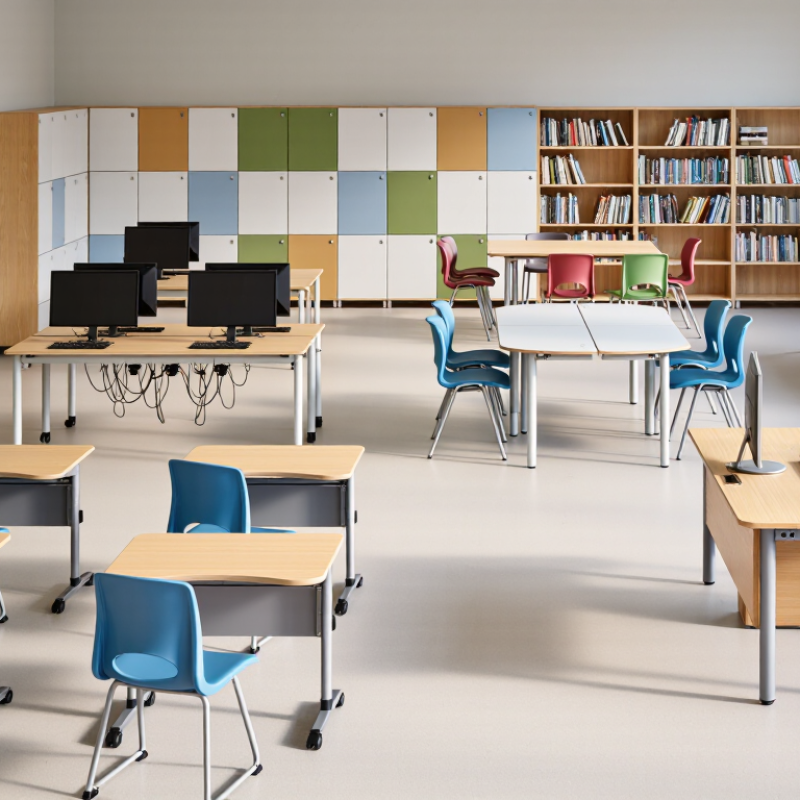
Top 10 School Furniture Types for Global Buyers?

What Defines School Furniture in Modern Learning Environments

Top 10 School Furniture Types for Global Buyers

Modern school furniture is no longer defined by rows of identical desks. It must support movement, collaboration, accessibility, and digital learning. The ten practical categories include adjustable student desks, ergonomic chairs, collaborative tables, mobile stools, laboratory benches, teacher stations, storage units, library shelving, soft seating, and presentation boards. Each type should suit the lesson, not simply fill the room.

Adjustability matters. A 2023 OECD education report links supportive learning environments with student engagement and well-being, although furniture alone cannot solve poor teaching conditions. Desks with height ranges, rounded edges, and lockable casters help pupils shift from writing to group work.

Small details matter. A chair that tilts slightly may reduce restless movement. A table that folds can free space for experiments or wheelchair access. Buyers should request tested load capacity, surface durability, and replacement-part availability.

Hygiene also defines modern furniture. The WHO and UNICEF Joint Monitoring Programme reported that about 23% of schools lacked basic hygiene services in 2022. Cleanable laminate, sealed joints, and washable upholstery therefore deserve more attention. Storage should keep cables, books, and science materials visible but controlled. That sounds simple. It rarely is. Overly flexible rooms can become noisy, crowded, and difficult to supervise. Global buyers need local trials, not only attractive catalog images. The UNESCO 2023 Global Education Monitoring Report also warns that technology benefits learning only when its use is purposeful. Furniture should support screens without making screens the center of every lesson.

The Ten Essential School Furniture Types for Global Buyers

Top 10 School Furniture Types for Global Buyers

The ten essential school furniture types serve different learning moments. Student deskssupport focused writing, while adjustable Student Chairs reduce awkward knee and back angles.Collaborative tables encourage group work, especially in classrooms using project-based learning. Teacher desks provide planning space, but they should not dominate the room. Storage cabinets and bookshelves keep materials visible, secure, and reachable. Library seating needs softer edges and quieter surfaces. Laboratory benches require chemical-resistant tops and generous clearance. Cafeteria tables need washable finishes and stable frames. Computer tables should manage cables safely. Outdoor benches extend learning beyond four walls.

Grand View Research’s 2024 school furniture market analysis projects steady global growth through 2030, reflecting continued investment in education spaces. OECD Education at a Glance 2023 reports that member countries spend about 5% of GDP on education. Procurement teams should connect that investment with measurable durability. A desk that survives ten years may cost less than three replacements. China School Furniture suppliers can support global buyers with varied materials, modular sizes, and export-oriented production experience. However, low price alone is a weak specification. Check EN 1729 or equivalent dimensional standards, load testing, edge safety, moisture resistance, and replacement-part availability. Ask for sample units. Sit in them. Measure aisle clearance with real schoolbags. My practical concern is simple: flexible furniture can become clutter quickly. Wheels are useful, but uncontrolled movement disrupts lessons. A careful layout still matters more than fashionable design.

Classroom Seating and Desk Solutions for Different Age Groups

Choosing school furniture starts with age, body size, and classroom movement—not appearance alone. Early learners need low, stable chairs with rounded edges and tables for drawing, cutting, and group play. Seat height should let both feet rest on the floor. A wobbly chair distracts children and teachers.

For primary pupils, adjustable desks and chairs can support rapid growth across several school years. Desks with modest storage keep pencils visible without creating clutter. Chairs should encourage an upright posture while allowing small shifts. Fixed seating looks orderly, but it may not suit every child. That deserves careful review.

Secondary students need larger desks, stronger frames, and seating that supports longer study periods. Collaborative tables can help group work, while single desks protect quiet reading time. Global buyers should check dimensions, surface durability, edge finishing, and cleaning requirements before approval. Ask suppliers for material details, load-testing records, and sample units. Custom School Furniture can match local classroom sizes, but customization may complicate replacement parts and future expansion. A practical trial with teachers and students often reveals problems that drawings miss. Small details matter.

Top 10 School Furniture Types for Global Buyers: Classroom Seating and Desk Solutions for Different Age Groups
No. Furniture Type Typical Age Group Common Size Range Capacity Best-Fit Learning Environment Key Functional Features Important Global Purchasing Considerations
1 Early Years Activity Table and Chair Set Ages 2–5
Preschool and nursery
Table height: 450–550 mm
Seat height: 260–310 mm
Tabletop: 600–1200 mm long
4–6 children Art, play-based learning, reading, group activities and snack time Rounded corners, stable low-height construction, wipe-clean surfaces, lightweight chairs and easy adult supervision Check tip-resistance, pinch-point protection, low-VOC finishes, washable materials and compliance with local early-years safety requirements
2 Kindergarten Classroom Chair Ages 4–6
Kindergarten and reception
Seat height: 260–310 mm
Seat width: 280–340 mm
Seat depth: 260–330 mm
1 student Story time, basic desk work, creative activities and circle-time transitions Supportive backrest, broad feet, stackable design, smooth edges and durable molded or laminated surfaces Confirm chair dimensions against the matching table height; request load testing, stacking limits and cleaning-resistance information
3 Primary School Student Chair and Desk Ages 6–11
Primary and elementary school
Seat height: 340–380 mm
Desk height: 590–640 mm
Desk width: 600–700 mm
1 student Reading, handwriting, mathematics, examinations and individual work Ergonomic back support, book storage, rounded desktop edges, scratch-resistant laminate and optional linked configurations Use age-appropriate size coding, verify desk-to-chair compatibility and select surfaces that tolerate frequent cleaning and heavy daily use
4 Two-Student Collaborative Desk Ages 6–14
Primary and lower secondary
Desk height: 590–710 mm
Width: 1000–1200 mm
Depth: 450–600 mm
2 students Pair work, peer learning, project tasks and flexible classroom layouts Shared work surface, under-desk storage, cable-free design, easy reconfiguration and optional bag hooks Review floor-space efficiency, edge durability, noise during movement, storage capacity and compatibility with local classroom layouts
5 Single-Student Open-Front Desk Ages 9–18
Upper primary and secondary school
Desk height: 640–760 mm
Width: 600–700 mm
Depth: 450–600 mm
1 student Focused study, testing, language learning and classrooms requiring flexible seating Individual work area, open legroom, book basket or modesty panel, optional linking mechanism and stackable frame Compare flat-pack and assembled shipping costs, inspect weld quality, confirm replacement-part availability and check classroom fire requirements
6 Adjustable-Height Student Desk and Chair Ages 6–18
Multi-grade classrooms
Desk height adjustment: approximately 590–760 mm
Chair seat adjustment: approximately 340–460 mm
1 student Schools serving mixed ages, inclusive classrooms and long-term furniture programs Multiple height settings, replaceable feet, durable adjustment mechanism and improved fit across different student sizes Confirm adjustment increments, locking security, pinch-point protection, tool requirements and the availability of spare components
7 Mobile Folding or Flip-Top Training Table Ages 12–18
Secondary schools and vocational education
Table height: 710–760 mm
Width: 450–600 mm per user
Length: 1200–1800 mm
2–4 students Training rooms, examinations, workshops, presentations and multipurpose classrooms Lockable casters, folding or nesting frame, cable-management options, easy storage and rapid room reconfiguration Check caster locking performance, folded dimensions, shipping volume, tabletop load rating and floor compatibility
8 Computer or Digital Learning Desk Ages 11–18
Secondary and digital classrooms
Desk height: 710–760 mm
Width: 600–800 mm per user
Depth: 600–800 mm
1–2 students Computer laboratories, coding rooms, media studies and blended learning Cable routing, monitor clearance, CPU or device storage, durable worktop and rounded front edge for seated use Confirm electrical and data-routing requirements separately, review ventilation around equipment and select materials resistant to abrasion and disinfectants
9 Science Laboratory Table and Stool Ages 12–18
Secondary and technical education
Table height: 760–900 mm
Stool seat height: 450–650 mm
Depth: 600–750 mm
2–4 students Biology, chemistry, physics, engineering and practical experiments Chemical-resistant worktop options, robust frame, service access, under-table storage and easy-clean stool surfaces Specify resistance to chemicals, heat and moisture; coordinate utility services with qualified professionals and follow applicable laboratory safety rules
10 Lecture Hall Tablet-Arm Chair Ages 16+
Colleges, universities and adult education
Seat height: 430–480 mm
Writing tablet width: 300–400 mm
Row pitch: commonly 850–1050 mm
1 learner Lectures, seminars, examinations and high-density teaching spaces Integrated writing tablet, foldable seat, aisle or floor fixing, optional power/data access and upholstered comfort options Check accessibility spacing, aisle and egress rules, tablet handedness, fire performance of upholstery and installation requirements
Dimensions are commonly specified metric ranges for planning and comparison. Final selection should be verified against students’ body sizes, local ergonomic guidance, accessibility rules, fire regulations, room layouts and applicable national standards.

Storage, Collaboration, and Activity Furniture for Schools

School furniture should support movement, storage, and purposeful teamwork, not simply fill a classroom. Global buyers often select ten practical types.

Lockers cubbies bookcases mobile storage carts collaborative tables modular chairs soft seating activity tables maker benches display units

Each type should match the students’ ages, room size, cleaning routines, and local safety requirements. That sounds obvious. It is often missed.

Lockers and cubbies keep bags off walkways, while bookcases place reading materials within easy reach. Mobile carts can carry art supplies between rooms and reduce repeated lifting.

For younger learners, rounded edges, stable bases, and wipe-clean surfaces matter every day.

Collaborative tables should let small groups face each other without blocking circulation. Adjustable heights support mixed-age classrooms, though moving parts require regular inspection.

Activity tables and maker benches need durable tops for cutting, drawing, experiments, and construction. Soft seating can create reading corners, but fabric may absorb stains and demand stricter maintenance.

Display units make student work visible and support learning conversations.

A reliable specification should state load limits, material composition, assembly needs, replacement parts, and tested safety performance.

Do not judge furniture from photographs alone. Ask for samples, installation guidance, and documented quality checks.

Even a well-planned room can feel crowded after one busy term. That feedback should reshape the next purchase.

Specialized Furniture for Laboratories, Libraries, and Administration

Top 10 School Furniture Types for Global Buyers?

Specialized furniture for laboratories, libraries, and administration deserves careful attention. These spaces support experiments, independent reading, and daily school operations. The World Bank and UNESCO estimated that 70% of children in low- and middle-income countries faced learning poverty in 2022. Better environments cannot solve this alone, but they can reduce practical barriers.

Laboratory furniture should include chemical-resistant worktops, lockable storage, adjustable stools, and clear circulation zones. Rounded edges matter when students move quickly. Library furniture needs quiet reading tables, mobile shelving, charging areas, and accessible seating. It should welcome different ages and body sizes. Administration areas often require ergonomic desks, secure filing units, visitor chairs, and acoustic partitions. The OECD’s PISA 2022 report connected supportive school conditions with student engagement, although furniture is only one part of that relationship. We should not overclaim.

Tips: Request load ratings, material certificates, replacement-part policies, and installation drawings. Test one sample before placing a large order. In my experience, attractive furniture can fail when cleaning routines, humidity, or local repair skills are ignored.

NCES reported in its 2020–21 School Pulse Panel that many schools identified facility upgrades as a continuing need. Buyers should therefore examine durability beyond the product photograph. Laboratory benches need cleanable joints. Library shelves need stable anchoring. Administrative chairs need adjustable lumbar support. A lower-cost option may become expensive after repeated repairs. That is worth questioning.

Top 10 School Furniture Types for Global Buyers

Typical module widths for specialized furniture used in laboratories, libraries, classrooms, and administration.

The values represent commonly specified module widths in educational environments. Actual dimensions may vary according to room layout, accessibility requirements, safety standards, and local procurement specifications.

Key Standards for Safety, Ergonomics, Durability, and Sustainability

Global buyers of Wholesale School Furniture should treat safety as a daily-use requirement, not a catalogue claim. Inspect rounded corners, stable frames, pinch-point protection, and non-toxic surface finishes. Ask suppliers for test reports that match the destination market. Standards may differ across regions, so one certificate is rarely enough.

Ergonomics affects attention, posture, and movement throughout the school day. Desks and chairs should fit different age groups, with suitable seat heights and supportive back angles. Adjustable options can reduce replacement costs as children grow. Check whether chair feet remain steady on tile, vinyl, and uneven classroom floors. Small details matter.

Durability needs practical evidence. Examine welded joints, hinge strength, edge banding, and scratch resistance. Request samples, weight tests, and cleaning trials before placing a large order. Sustainability should include recycled content, responsible timber, low emissions, repairable parts, and recyclable packaging. A durable product can create less waste over time.

No checklist is perfect. Even experienced purchasing teams may overlook noise, storage access, or awkward assembly. Ask for clear maintenance instructions and replacement-part availability. Record inspection results with photos, batch numbers, and delivery dates. This creates a reliable trail when quality problems appear. Some suppliers may resist extra testing, but that hesitation deserves attention.

How Global Buyers Can Compare Suppliers, Costs, and Custom Options

Top 10 School Furniture Types for Global Buyers

Global buyers compare school furniture by use, not appearance alone. Desks, chairs, storage units, laboratory tables, library shelving, lockers, and teacher stations each need different specifications. A classroom chair should support stable posture, resist daily movement, and match the student’s age group. Measure seat height, tabletop depth, edge safety, and floor clearance before requesting prices.

Supplier comparison needs more than a unit quotation. Ask for material details, load testing, moisture resistance, packaging photos, and production lead times. High-Quality School Furniture may cost more initially, but stronger joints and replaceable parts can reduce long-term spending. Check the minimum order quantity, sample charges, payment terms, and estimated shipping volume. A low price can hide weak packaging.

Look at the total landed cost. Include freight, import duties, inspection fees, local assembly, and possible replacement parts. Custom colors, rounded corners, recycled materials, and adjustable legs may improve a project, but every option affects cost and delivery. Request a written specification sheet and approve a physical sample when possible. Small differences matter. A three-centimeter height error can make a desk uncomfortable for younger pupils.

In practical procurement reviews, suppliers sometimes provide attractive photos but vague technical information. That should invite questions, not quick approval. Warranty wording also deserves careful reading, especially for hardware failures and transit damage. No comparison is perfect; classroom conditions differ widely. Recheck assumptions with teachers, installers, and facility managers before placing a large order.

FAQS

What furniture suits early learners best?

Choose low, stable chairs with rounded edges. Both feet should rest flat on the floor. Tables should support drawing, cutting, and group play.

Why are adjustable desks useful for primary pupils?

Children grow quickly across several school years. Adjustable desks and chairs can follow changing body sizes. Small storage keeps pencils visible, but too much storage creates clutter.

Should primary classrooms use fixed seating?

Fixed seating looks orderly, but it may not fit every child. Chairs should support upright posture and allow small movements. This deserves careful review.

What should secondary-school furniture provide?

Secondary students need larger desks and stronger frames. Seating should remain comfortable during longer study periods. Collaborative tables support group work, while single desks protect quiet reading.

What should buyers inspect before approving furniture?

Check dimensions, surface durability, edge finishing, and cleaning requirements. Request material details, load-testing records, and sample units. Drawings may miss real classroom problems.

What features belong in laboratory furniture?

Laboratories need chemical-resistant worktops and lockable storage. Adjustable stools support different students. Clear circulation zones and rounded edges reduce problems during quick movement.

How should library and administration furniture differ?

Libraries need quiet reading tables, mobile shelving, charging areas, and accessible seating. Administration areas need ergonomic desks, secure filing units, visitor chairs, and acoustic partitions.

Is customized school furniture always the better choice?

Custom furniture can match local classroom sizes and unusual layouts. However, it may complicate replacement parts and future expansion. Test one sample first. Beautiful furniture can fail when humidity, cleaning routines, or local repair skills are ignored.

Conclusion

School Furniture plays a central role in creating safe, flexible, and effective modern learning environments. This article introduces ten essential furniture types for global buyers, including desks, chairs, storage units, collaborative tables, activity furniture, laboratory equipment, library shelving, and administrative workstations. It explains how classroom seating and desk designs can be adapted to different age groups, body sizes, learning activities, and space requirements.

The article also highlights the importance of selecting furniture that supports ergonomics, safety, durability, easy maintenance, and sustainable material use. Buyers will learn how to compare suppliers by evaluating product quality, certifications, production capabilities, delivery costs, customization options, and long-term value. By considering classroom, library, laboratory, administrative, and shared activity spaces together, schools can develop a coordinated furniture plan that improves comfort, organization, collaboration, and everyday learning outcomes.

Ethan

Ethan

Ethan is a dedicated marketing professional at Guangzhou Gaudi School Equipment Manufacturing Co., Ltd., where he leverages his expertise to enhance the company’s online presence. With a strong background in the education sector, he possesses an in-depth understanding of the products offered by......
Previous China Top School Chair With Desk Suppliers