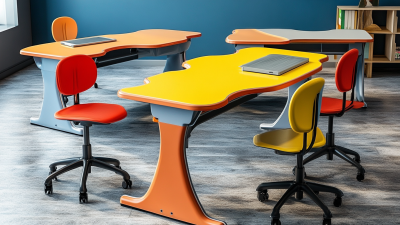
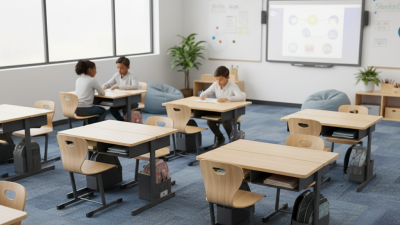
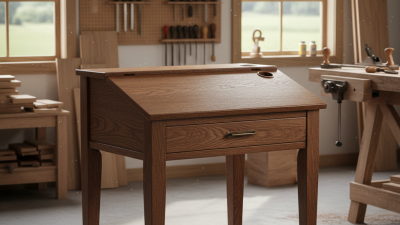
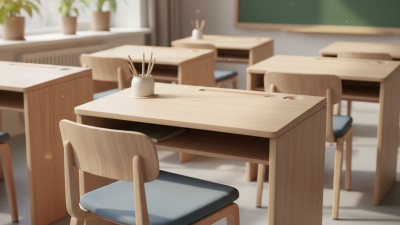
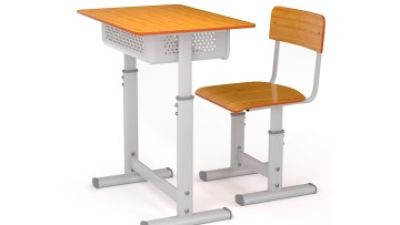
A Plywood School Desk is more than just a tiny table for kids to do their classroom work—it's kind of a little hub for learning. It usually features a plywood writing surface, sturdy legs, and proportions that are just right for young students. Some models even come with a matching seat, turning it into a full set for reading, drawing, or group activities. If you want to see a complete set, check out thisPlywood School Desk And Chair.
According to Michael R. Hayes, a School Furniture expert from Learning Space Works, "A good school desk should support focus without making kids feel cramped." That’s really key because you want a desk that feels stable but isn’t so heavy that teachers can’t shift it around easily. The edges should feel smooth to little hands, and the surface needs to hold up against pencils, spills, and heavy cleaning routines.
Now, why plywood? Well, it has some real perks. With cross-laminated layers, it becomes stronger and less likely to warp over time. Plus, the warm, visible grain of the wood adds a touch of warmth to any classroom—making it feel a bit less rigid and more inviting. That said, plywood isn’t indestructible. If it’s not sealed properly, moisture can sneak in around the edges, and over months of use, some joints might loosen up.
The best designs really pay attention to things like posture, how easy it is to clean, the size of the classroom, and how easy it is to repair if needed. For kids, height is important—something that’s too high or too low can cause discomfort, especially during a long day. Same goes for leg clearance; tiny mistakes become pretty obvious after a while.
Honestly, there’s no such thing as a perfect desk. When choosing one, it’s smart to test out how it feels in real life—not just look at glossy pictures. Teachers might care about how easy it is to move around, while kids probably want personal storage space. Sometimes those needs can clash. So, picking the right desk means doing practical testing, listening to honest feedback, and making sure it’s well-made.

A Plywood School Desk is defined by more than a wooden-looking surface. Its identity comes from material, structure, and classroom purpose. Plywood is built from thin wood veneers, with adjacent layers usually arranged across different grain directions. The USDA Forest Products Laboratory’s Wood Handbook explains that this cross-lamination improves dimensional stability and helps panels resist splitting.
The structure matters. A practical desk may use a 12–18 millimeter plywood top, sealed edges, and reinforced joints beneath the writing surface. Steel or solid-wood legs support repeated loading, while rounded corners reduce sharp contact points. Screws, bolts, and replaceable fittings can make repairs easier. In real classrooms, that detail matters. Students lean, drag, and sometimes stand beside desks. Designers should expect misuse, not pretend it will never happen.
Purpose also shapes the design. The desk must provide a stable writing plane, suitable knee clearance, and enough strength for daily movement. The FAO Global Forest Resources Assessment 2020 reports that forests cover about 31% of the world’s land area, making responsible wood sourcing an important design concern. However, plywood is not automatically sustainable. Its adhesive content, surface coating, manufacturing waste, and service life need separate evaluation. A desk may look warm and natural, yet still perform poorly if its edges swell after cleaning. That is an uncomfortable but necessary point.
A plywood school desk uses thin wood veneers bonded into a stable panel. Each layer crosses the next, reducing warping from classroom humidity. The USDA Forest Products Laboratory’s Wood Handbook, FPL-GTR-282, describes plywood as a panel made from three or more veneer plies. A five-ply top can feel firm under books, elbows, and daily writing pressure. The exposed edge often reveals alternating grain lines.
Veneer grades affect appearance and serviceability. ANSI/HPVA HP-1 sets requirements for hardwood and decorative plywood, including face quality, core construction, bonding, and panel tolerances. Higher face grades usually show fewer knots, patches, and open defects. Lower grades may remain practical when the surface receives a durable finish. However, grade names alone do not prove desk strength. Core gaps, weak glue lines, and poor edge sealing can still cause problems. I would inspect the panel, not trust the label blindly. A “China Plywood School Desk And Chair” specification should identify veneer grade, thickness, formaldehyde class, and testing method.
Tips: Check the tabletop edge for visible voids. Press near corners for movement. Ask for test records covering load, moisture resistance, and bond durability. A 2023 education-furniture procurement review from a regional standards laboratory found that repeated edge impacts were a common failure point in student furniture. That detail deserves attention. A neat surface can hide a fragile core.
A plywood school desk is a student work surface built from layered wood veneers. Its value depends on more than strength or appearance. Edge safety, stable legs, knee clearance, and correct height matter during real classroom use. A desk can look right and still feel wrong.
EN 1729-1:2015 classifies educational furniture by pupil stature, not simply age. The standard defines eight size classes, from Size 0 to Size 7. Approximate pupil-height ranges run from 80–95 cm in Size 0 to 174–207 cm in Size 7. Common desk-height references include about 400 mm for Size 0, 590 mm for Size 3, 640 mm for Size 4, 710 mm for Size 5, and 760 mm for Size 6. These figures come from the European Committee for Standardization’s functional-dimension tables.
Fit needs checking in person. The student’s feet should rest firmly on the floor, while the forearms remain close to horizontal. A 10 mm error may feel minor on a drawing. It feels different after a long lesson. Desk depth also needs space for notebooks without forcing the student forward. Plywood thickness, usually selected for rigidity and screw holding, can reduce knee clearance if the frame is oversized. EN 1729-1 gives a reliable starting point, but classroom measurements are still necessary. One chart cannot capture every child.
What Is a Plywood School Desk?
Safety and Stability: BIFMA Testing for Educational Desk Products
A plywood school desk combines layered wood panels with a supporting frame. Its surface may show subtle grain, rounded edges, and sealed corners. In daily use, students lean, write, shift chairs, and sometimes pull the desk sideways. These actions create repeated stress around joints, screws, and legs.
BIFMA testing provides a structured way to examine educational desk performance. BIFMA develops voluntary furniture standards, while independent laboratories may apply suitable test methods. Testing can examine static strength, repeated loading, stability, impact resistance, and connection durability. A technician may load the work surface, rock the frame, or repeat movement cycles. Measurements reveal wobble, cracks, loose fasteners, and permanent deformation.
Small details matter.
For plywood products, inspectors should also check delamination, chipped edges, and moisture-related swelling. A desk can pass one test and still feel unstable on an uneven classroom floor. Laboratory conditions cannot reproduce every careless movement or crowded storage area. That limitation deserves honest attention. Purchasers should review the exact test scope, sample construction, and reported results, rather than relying on a general compliance statement. Practical evaluation should include a fingertip check for sharp edges, a visual inspection beneath the desktop, and a stability check after assembly. Stability is felt before it is measured.
| Data Dimension | Plywood School Desk Information | Safety or Performance Relevance | BIFMA Testing Consideration |
|---|---|---|---|
| Product Definition | A school desk with a work surface made from multiple wood veneer layers bonded together, usually supported by a metal, solid-wood, or plywood frame. | Cross-laminated layers can provide more uniform dimensional stability than a single solid-wood panel. | The complete desk assembly, rather than the plywood panel alone, should be evaluated under the applicable desk-product requirements. |
| Common Panel Construction | Commercial plywood commonly uses an odd number of veneer plies with adjacent grain directions arranged approximately perpendicular to one another. | Balanced construction helps reduce warping, splitting, and uneven movement caused by changes in moisture. | Inspectors should check panel attachment, joint integrity, and structural behavior during load and durability evaluations. |
| Typical Work-Surface Thickness | Approximately 12–18 mm is a common design range for a plywood desktop, depending on span, support spacing, edge treatment, and expected use. | Thickness alone does not establish safety; unsupported span, fasteners, joints, and frame geometry also affect stiffness and strength. | The product should be tested in its finished configuration, including the selected panel thickness and support structure. |
| Typical Desk Height | Fixed school desks are often designed within an approximate 520–760 mm height range to serve different student age or stature groups. | Correct height supports ergonomic posture and helps reduce uncomfortable shoulder, wrist, and knee positions. | BIFMA desk-product evaluation focuses on structural performance; ergonomic sizing should also be checked against the intended student population. |
| Work-Surface Shape | A rectangular top with rounded front corners and eased edges is commonly used for classroom desks. | Rounded corners and smooth edges reduce the likelihood of cuts, snagging, and impact injuries during normal classroom movement. | Visual and tactile inspection should confirm that accessible edges and corners do not create foreseeable hazards. |
| Edge Treatment | Edges may be sealed with a durable coating, hardwood edging, or a bonded edge band; exposed plywood edges should be sanded and sealed. | Sealing limits moisture ingress and helps prevent veneer lifting, splinters, and premature deterioration. | After durability testing, examine edges and joints for sharp projections, delamination, looseness, or hazardous damage. |
| Frame and Joint Design | Common systems include welded steel frames, bolted frames, dowel-and-screw joints, and reinforced plywood supports. | Joint geometry and fastener retention are major contributors to wobble resistance and long-term stability. | Test the actual frame, fasteners, glides, and attachment points together; do not infer complete-product performance from material specifications alone. |
| Static Load Performance | The desk should support foreseeable classroom loads such as books, writing materials, and reasonable incidental leaning without permanent structural damage. | Static-load evaluation helps identify excessive deflection, cracking, fastener pull-out, and joint failure. | ANSI/BIFMA desk-product testing includes structural load evaluations using defined procedures and acceptance criteria; the current applicable edition should be confirmed before testing. |
| Stability and Tip Resistance | A broad support footprint, level-adjusting glides, low center of gravity, and secure frame-to-top connections improve stability. | Stable desks are less likely to rock, slide, or tip when students lean on the front or side of the work surface. | Stability testing should be conducted on the fully assembled product and with relevant components adjusted as specified in the instructions. |
| Durability and Repeated Use | Classroom desks experience repeated loading, movement, cleaning, and occasional impact over their service life. | Repeated-use testing can reveal progressive loosening, fatigue cracks, veneer separation, and loss of stability. | BIFMA durability procedures are intended to assess repeated-use performance; results apply only to the tested design and configuration. |
| Fasteners and Hardware | Threaded inserts, machine screws, bolts, washers, and reinforced mounting plates are suitable options where repeated assembly or high joint demand is expected. | Proper hardware reduces joint loosening and distributes loads more effectively than poorly supported screws in thin plywood. | Check hardware retention, joint movement, and accessibility of moving or removable parts after load and durability testing. |
| Moisture and Surface Protection | A sealed surface and sealed edges help protect the plywood from routine cleaning and short-term contact with spilled liquids. | Moisture protection helps limit swelling, delamination, staining, and loss of edge integrity. | Moisture resistance is not a substitute for structural testing and should be assessed through separate material or finish evaluations where required. |
| Pinch, Shear, and Entrapment Hazards | Fixed desks generally have fewer moving-part hazards than adjustable desks, but folding, tilting, or height-adjustable designs require additional safeguards. | Clearances, guarded mechanisms, and controlled movement help prevent finger injuries. | Inspect and test all accessible moving parts under foreseeable use conditions, following the applicable safety procedure. |
| Documentation and Maintenance | Assembly instructions should specify fastener torque or tightening guidance, periodic inspection points, maximum intended load, and replacement-part information. | Routine inspection helps identify loose hardware, damaged edges, cracked panels, unstable legs, and worn glides before they become safety problems. | A test report should identify the product configuration, components, procedures, observed failures, and acceptance results; a general statement of compliance is not a substitute for documented testing. |
Note: ANSI/BIFMA standards are voluntary consensus standards unless adopted or referenced by a purchaser, authority, contract, or applicable regulation. Confirm the current edition and scope of the relevant desk-product standard before commissioning or interpreting test results.
A plywood school desk is more than a flat work surface and four legs. Its panels may contain resins that release formaldehyde, especially in warm classrooms with limited ventilation. Under TSCA Title VI, hardwood plywood must meet a formaldehyde emission limit of 0.05 ppm. This is an emissions standard, not a direct measurement of classroom air.
The U.S. Environmental Protection Agency’s TSCA Title VI Compliance Guide explains that regulated composite wood requires testing, labeling, and documented certification. The limit is measured through controlled chamber methods. Real classrooms behave differently. Sunlight can warm a desktop, while tightly closed windows slow air exchange. Small details matter.
The World Health Organization’s Air Quality Guidelines identify 0.1 mg/m³ as a 30-minute indoor formaldehyde guideline, roughly 0.08 ppm under common conditions. That comparison is useful, but not perfect. Different test methods and exposure periods can change the result. A Custom Plywood School Desk And Chair should therefore use compliant panels, sealed edges, and low-emitting finishes. Check the documentation.
Fresh air still matters.
In practice, I would inspect the desk after delivery. A sharp chemical odor may fade, yet odor alone cannot prove safety. The EPA’s Indoor airPLUS guidance also emphasizes source control and ventilation. One overlooked issue remains: a compliant panel does not guarantee perfect indoor air quality when several new products enter the same classroom.
A plywood school desk is built from thin wood veneers bonded into a stable panel. Each layer crosses direction, which helps reduce warping under daily classroom use. Manufacturers usually cut panels with CNC equipment, smooth the edges, and seal exposed surfaces. Rounded corners matter because they reduce sharp contact points during busy school hours. A durable desk also needs strong joints, accurately fitted screws, and a moisture-resistant finish.
Maintenance is simple, but consistency decides the result. Wipe the surface with a slightly damp cloth, then dry it promptly. Do not leave wet bottles or cleaning liquid near unsealed edges. Inspect screws every few months, especially when the desk begins to wobble. Small chips should be repaired before moisture reaches the inner layers. In workshop inspections, loose fasteners often cause more damage than the plywood itself.
For buyers comparing Wholesale Plywood School Desk And Chair options, service life should be judged by construction and environment. A well-made desk may serve for eight to fifteen years in a controlled classroom. Heavy movement, damp floors, and careless stacking can shorten that period. Real service life is less tidy. Some desks remain solid after a decade; others fail early because maintenance was ignored. That difference deserves attention.
Sourcing quality classroom desk and chair sets from reliable Chinese factories requires more than comparing prices. Buyers should assess production experience, material standards, quality-control procedures, and communication efficiency before placing an order. A dependable factory should be able to provide clear product specifications, sample approval, inspection records, and consistent production capacity. It is also important to confirm whether the supplier can support different classroom layouts, age groups, and quantity requirements while maintaining stable quality.
Product Code GD-G03 is sourced directly from trusted Chinese manufacturers specializing in classroom furniture. The set is designed with practical proportions, durable construction, and student-friendly details to support comfortable learning environments. Before shipment, key elements such as frame strength, surface finish, edge treatment, weld quality, and hardware stability should be checked carefully. Buyers can also request samples or pre-production inspections to verify that the final goods match the approved requirements.
When working with a Chinese factory, clear communication helps prevent delays and misunderstandings. Confirm packaging methods, loading arrangements, production timelines, customization options, and after-sales support in writing. Reliable suppliers should respond promptly, explain technical details accurately, and provide suitable solutions for bulk orders. By combining factory verification with systematic quality inspections, schools, distributors, and procurement teams can source dependable desk and chair sets while making better use of China’s manufacturing expertise.
It uses thin wood veneers bonded into a stable panel. Each layer crosses the next, reducing warping. The edge often shows alternating grain lines. A five-ply top feels firm under books and elbows.
Higher grades usually show fewer knots, patches, and open defects. Lower grades can still work with a durable finish. Grade names alone do not prove strength. Inspect the actual panel.
Look for visible voids along the edge. Press near each corner for movement. Weak cores may hide beneath neat surfaces. This is easy to overlook.
ANSI/HPVA HP-1 covers face quality, core construction, bonding, and panel tolerances. Ask for veneer grade and thickness details. Request test records when available. Do not trust a label blindly.
Core gaps, weak glue lines, and poor edge sealing can create problems. Repeated edge impacts deserve attention. A 2023 regional review identified edges as common failure points. Neat surfaces can mislead.
EN 1729-1:2015 classifies furniture by pupil stature. It defines eight size classes, from Size 0 through Size 7. Approximate height ranges run from 80–95 centimeters to 174–207 centimeters.
Common references include 400 millimeters for Size 0 and 590 millimeters for Size 3. Size 4 is about 640 millimeters. Size 5 is about 710 millimeters. Size 6 is about 760 millimeters.
The student’s feet should rest firmly on the floor. Forearms should remain close to horizontal. The desk needs enough depth for notebooks. Measure twice. A 10-millimeter error can feel uncomfortable after a long lesson.
No. Classroom measurements still matter. Oversized frames can reduce knee clearance. Plywood thickness may also affect leg space. One chart cannot capture every child. That limitation deserves honest attention.
A Plywood School Desk is a student workstation made from engineered wood panels formed by bonding thin veneer layers in alternating directions. This construction provides a practical balance of strength, dimensional stability, weight, and cost. The desk’s quality depends on plywood grades, surface finish, edge treatment, and compliance with relevant material guidance such as ANSI/HPVA HP-1. Its size and proportions should support proper posture, with EN 1729-1 size classes helping match desk height and clearance to different student age and body dimensions.
Safety and long-term usability are also essential. Educational desk products should be checked for stability, load resistance, sharp edges, and durability through suitable BIFMA testing methods. Indoor air quality matters as well, so low-emission panels should meet the TSCA Title VI formaldehyde limit of 0.05 ppm for applicable hardwood plywood. With accurate manufacturing, regular cleaning, prompt repairs, and protection from excessive moisture, a plywood desk can provide reliable service for many years.